
At some point, every photographer asks the same thing: how much editing does this picture really need? There is more to the answer than just personal choice. The final product’s level of polish, the industry, the client, and how the image will be used all play a role.
One of the most useful things a photographer or creative professional can do is learn the difference between basic and high-end photo editing. It has an effect on your pricing, your workflow, how you talk to clients, and in the end, your reputation. This guide makes it easy to understand what to offer whether you’re a portrait photographer or what amount of retouching your campaign photographs need if you’re a brand manager.
Photodotedit has both tiers, with simple retouching starting at under $1 per image and high-end and magazine-level work costing between $5 and $20 each image. Their editing staff works with high-resolution RAW images and tries to make the outcomes look as natural and lifelike as possible. But before you start looking for a place to get retouching done, it’s important to know what each level means.
What Is Basic Photo Retouching?
Basic retouching is the first step in post-production. It fixes the most obvious and urgent flaws in a picture without diving too far into structural or textural work.
What Basic Retouching Usually Involves
- Blemish and spot removal: Using the healing brush or clone stamp tool to get rid of transitory skin problems like pimples, minor scars, or redness that showed up on the day of the shoot.
- Skin smoothing: A modest, global smoothing pass that makes the texture less noticeable without getting rid of it completely. This is not the same as frequency separation. It works well for volume work when natural results are anticipated, but not at a high-end beauty level.
- Teeth whitening: Using a Hue/Saturation adjustment disguised to the teeth to make them a little brighter. The idea is to be clean, not fake white.
- Eye brightening: A small lift to the sclera and a small sharpening of the iris make the eyes look clear and awake.
- Global color and exposure correction: Changing the white balance, exposure, highlights, shadows, and contrast to make the picture look even and well-lit. This is the most important part of any edit.
- Minor background cleanup: getting rid of glaring distractions at the margins of the frame or tidying up a simple backdrop.
Who Basic Retouching Is Right For
Basic retouching is best for consistency and speed over perfection. School, real estate, family, event, and corporate headshots are included. We’ll view the photos on normal screens, not billboards or periodicals.
Photographers who take 50–100 shots every session save time and money with basic editing. Photodotedit charges $1 per image for simple portrait retouching, making it easy for large studios to outsource.
What Is High-End Photo Retouching?
High-quality retouching is distinct. Not just “more” retouching. Technically advanced retouching uses more tools, takes longer, and produces higher-quality work.
What High-End Retouching Includes
- Frequency separation: Frequency separation divides an image into two levels. Skin color and tone are on one layer. The other has texture and details. This allows a retoucher to correct uneven skin tone, blotchiness, and discoloration without altering skin’s natural pores, micro-texture, or surface detail. Skin is smooth and even but still looks like skin.
- Dodge and burn: Use dodge and burn to shape a gray layer in Soft Light blend mode. The retoucher manually brightens and darkens the face and torso to make the subject look three-dimensional. Each image takes 30–60 minutes and is bright and glossy without plasticity from over-smoothing.
- Advanced eye retouching: sharpening the entire iris, whitening the sclera in specific places with selective Hue/Saturation adjustments, improving iris micro-contrast, and repairing shadows under the eyes with Dodge or masked Curves.
- Professional hair retouching: removing flyaways from complex backdrops, correcting edges with path-based masking and the Pen tool, and adjusting hair color to remove overhead or background lighting casts.
- Body contouring: Small Liquify modifications to repair lens distortion artifacts or fix garment wrinkles that make bad shapes. After consulting with the client, done ethically.
- Advanced makeup correction: digitally changing lip color, eye definition, cheekbone structure, and complexion. Photoshop may be used to create digital makeup from scratch.
High-end retouching for architectural or product pictures involves blending many exposures for a realistic HDR effect and meticulously removing or replacing the backdrop.
Who High-End Retouching Is Right For
High-end retouching is needed for advertising, magazine covers, and brand images. Photo comparisons in journalistic layouts or larger prints show the difference. That level shows tone, texture, and light sculpting changes.
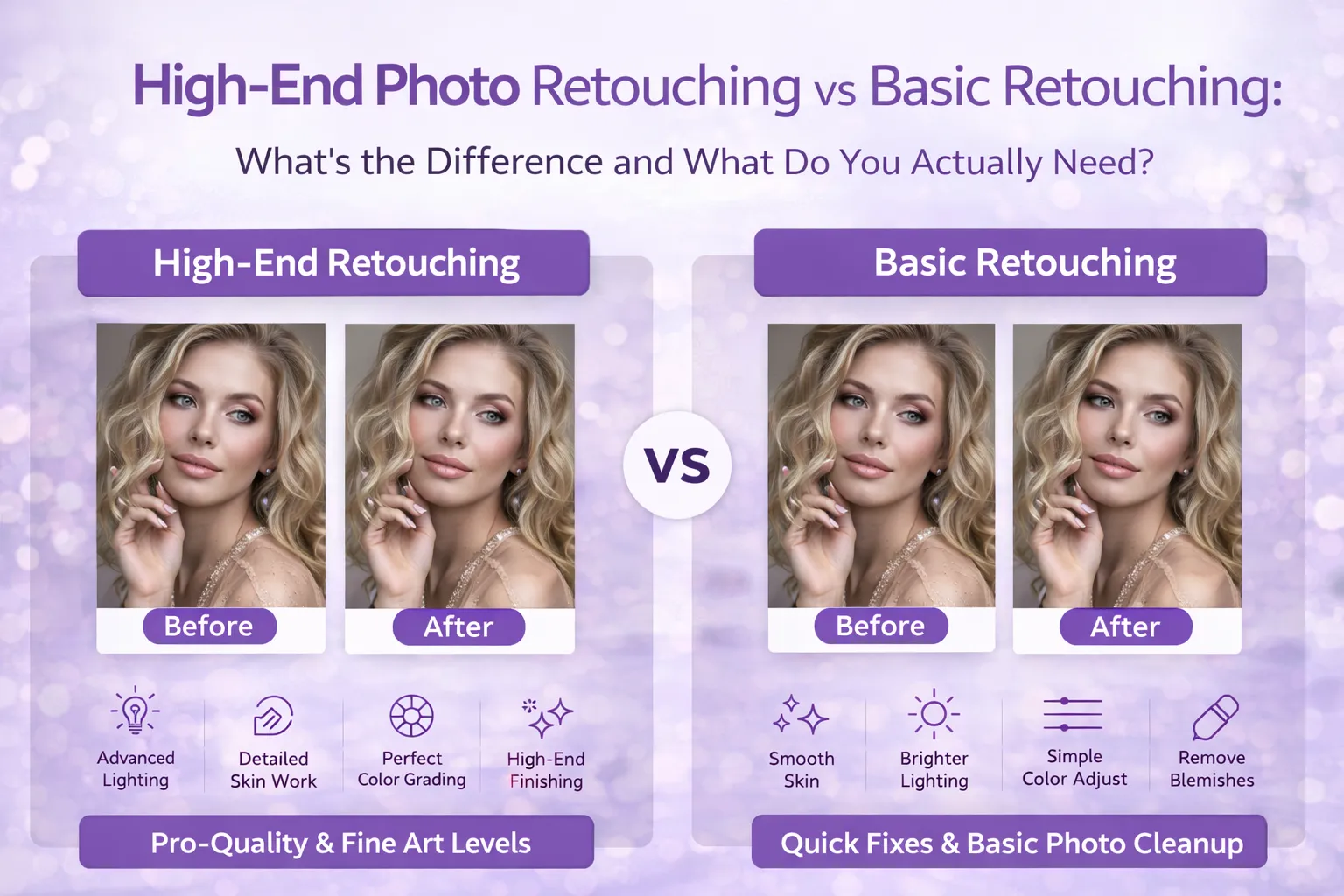
Basic vs High-End: A Side-by-Side Comparison
To see the difference, imagine the same portrait being worked on at each level.
- Basic version: Clean, right-exposed photo. No flaws anymore. Skin is slightly smoother. Clear, sparkling eyes. The topic seems natural and professional. Ideal for LinkedIn, family albums, and company websites.
- High-end version: The same photo has dimensional skin that captures light naturally and is dodge and burn-sculpted. People prefer to look at the deep, clear eyes. All sides of the hair are clean and smooth. Skin is evenly toned and not airbrushed. The picture would display well at magazine size without losing details.
The comparison is not about one being better in every situation. It is about matching the level of work to the purpose of the image.
| Feature | Basic Retouching | High-End Retouching |
| Blemish removal | Yes | Yes |
| Skin smoothing | Light, global | Frequency separation |
| Dodge and burn | No | Yes |
| Eye detail work | Basic brightening | Full iris and sclera work |
| Hair retouching | Minimal | Flyaway removal, edge masking |
| Body contouring | No | Subtle Liquify |
| Background work | Minor cleanup | Full replacement or compositing |
| Time per image | 5 to 15 minutes | 30 to 60+ minutes |
| Starting price | $1 to $2 per image | $5 to $20 per image |
Which Industries Need High-End Retouching?
- Beauty and Cosmetics: Promoting beauty sells skin. The company’s values are shown in every photo, whether for skin, makeup, or hair care. Retouching skin to look natural is no joke. Highly skilled skin retouching employing frequency separation and dodge and burn is common here. People look at photos on enormous displays and in print, so they notice the skin.
- Fashion and Editorial: The greatest visual requirements apply to fashion pictures. This retouching is deliberate and stylistic. High-quality touches are applied to skin, clothes, hair, and cosmetics. The same work should be used throughout an editorial layout or campaign. Photodotedit charges $5–$20 per image for magazine-level retouching, which is appropriate.
- Advertising and Commercial Photography: Advertising photos of people, products, or settings represent a brand. Retouching makes vehicles, watches, food, architecture, and other consumer goods look expensive and planned. Pictures of products with distracting reflections, models with uneven skin tone, or spaces with distracting backgrounds will dilute the campaign’s message.
- Boudoir Photography: Photographers and clients must trust each other for boudoir sessions. High-end body retouching comprises restoring skin tone, adding suntan effects, removing temporary marks, and meticulously improving the face to please the client. Photodotedit charges $3–$10 per image for boudoir retouching, depending on the amount of work.
Which Photographers Should Offer High-End Retouching?
Professional retouching is not necessary for all photographers. This helps you find your place.
- Business and personal brand portrait and headshot photographers should retouch cleanly. Unless the consumer is a celebrity or executive who needs magazine-quality work, basic retouching is fine.
- Fashion and beauty photographers for businesses, agencies, and periodicals must undertake high-end retouching. These workers expect it. No matter how excellent the shot, little retouching on a beauty brand will make the photographer appear horrible.
- Most wedding photographers conduct basic editing, but some do high-end work on critical photographs. Covers, first looks, and bridal photos are retouched more than the gallery, which is simple.
- Product and commercial photographers need the best work for ad hero shots and basic work for catalog images. Knowing which photos are hero shots and charging the proper amount streamlines the process.
Photodotedit contains both levels for photographers who don’t want to retouch much. Upload your photos to their secure gateway, specify the amount of retouching, and receive the finished photos within 24 hours. You can make unlimited modifications for free until the results fit your style criteria.
Photo Retouching Pricing: What to Expect at Each Level
Price is one of the best indicators of work quality.
- Basic Retouching Pricing: Portrait retouching costs $1–2 per photo. Blemishes, skin smoothing, eyes, teeth, and color correction are included at this price. At this level, Photodotedit costs $1/image.
- High-End Retouching Pricing:
- High-end retouching covers more scope, depending on what is covered. Photodotedit’s high-end version costs $3–$10 per image and includes skin retouching, body sculpting, dodge and burn, boudoir retouching, cosmetics corrections, clothes smoothing, and more.
- Their Standard Magazine tier costs $5–$20 per image for skilled photographers. High-end beauty correction, advanced hair and eye retouching, HDR mixing, backdrop change, and up to three people in one photo are included.
- The Premium Magazine level adds head, torso, and detail swaps, photo merging, jewelry retouching, and group retouching for $10–$30 each image.
- Is High-End Retouching Worth the Price?
- Yes, assuming photographs are correct. A cosmetic brand’s hero campaign or fashion editorial spread must be flawless. Thousands of dollars can be spent on the session, including high-end retouching.
- Basic retouching for many photographs for $1–2 is a bargain. For images that define a brand, are part of a major campaign, or are widely seen, high-end retouching is worth it.
Turnaround Time: Basic vs High-End
The time to turn around depends on how long each image level takes to retouch.
Each photo requires 5–15 minutes of basic tweaking. You can probably finish 50 photos in 24 hours.
High-end retouching, notably dodge and burn and full eye and hair restoration, takes 30–60 minutes per image. A high-end batch of 20 photographs takes longer, and quality can’t be rushed.
Due to their professional retouchers and equipment, Photodotedit can deliver both levels in 24 hours. Self-editing photographers can spend a day on a high-end batch of 20 shots.
Hiring someone to conduct high-end retouching is one of the top reasons. Spending a lot of time on one client’s pixels leaves no time for photography, sales, or business growth.
How to Communicate Retouching Levels to Clients
Different retouching standards are a common issue in commercial photography. Customers who have seen changed beauty commercials may want the same treatment for their business pictures. A photographer who only conducts basic retouching may not know that the buyer requested more.
- Set the Standard Before the Shoot: Explain the retouching level in each bundle. Speak frankly. Basic work: “blemish removal, skin smoothing, and color correction.” High-end work: “frequency separation skin work, dodge and burn, hair cleanup, and eye enhancement.”
- Use Visual Examples: Showing before-and-after photos is a great method to manage client expectations. Clients can better understand their payments when they see the difference.
- Price Separately When Appropriate: If you already do basic retouching, you can charge per image for high-end retouching. This lets buyers pick their quality. You can enhance a session’s hero photos without changing the gallery.
- Be Honest About Timelines: High-end retouching takes longer. Job types alter if a client needs images in 24 hours. Being upfront prevents disappointment for both parties.
Get High-End Retouching from $5 Per Image
You may achieve consistently fantastic results by knowing where your work is on the retouching spectrum. Retouching the basics keeps bulk work moving swiftly. Beauty, fashion, advertising, and editorial photos benefit from high-end retouching.
Photodotedit can save you time if accurate retouching is taking up your photography and client time. They offer simple and high-end retouching, and new clients get a complimentary edit. Free unlimited revisions and 24-hour turnaround are also available for both sorts of orders.
Send your first photo to [email protected] for free or use their live chat to discuss your project’s retouching needs. Please email [email protected] or call +91-8130136092 for service.
Photographers protect their reputation, meet customer expectations, and build a method by matching retouching to the image.
What is the main difference between basic and high-end photo retouching?
Fixing little eye and tooth issues, smoothing pale skin, and erasing blemishes are basic retouching. Dodge and burn, frequency separation, eye and hair treatment, body shaping, and meticulous backdrop work are high-end retouching techniques. This makes the image more polished and three-dimensional.
How much does high-end photo retouching cost per image?
Regular high-end retouching costs $3–$5 each image. Premium magazine-level alterations that include several subjects, background replacement, and compositing cost $20–30 per image.
When should I use high-end retouching instead of basic?
Ads, fashion editorials, beauty brand content, large-format printing, and other situations where the image will be seen by many people require high-end retouching. Basic retouching is sufficient for everyday photos, headshots, and family sessions.
Does high-end retouching look natural?
Certainly if done well. Retouching professionals aim to improve without modifying. Frequency separation maintains skin texture and tone. Dodging and burning light without smoothing. Not a digital copy, the result should be the best version of the topic.
How long does high-end retouching take per image?
High-end retouching takes 30–60 minutes each photo, including dodge and burn, extensive eye and hair treatment, and skin refinement. Basic editing usually takes 5–15 minutes per photo.