
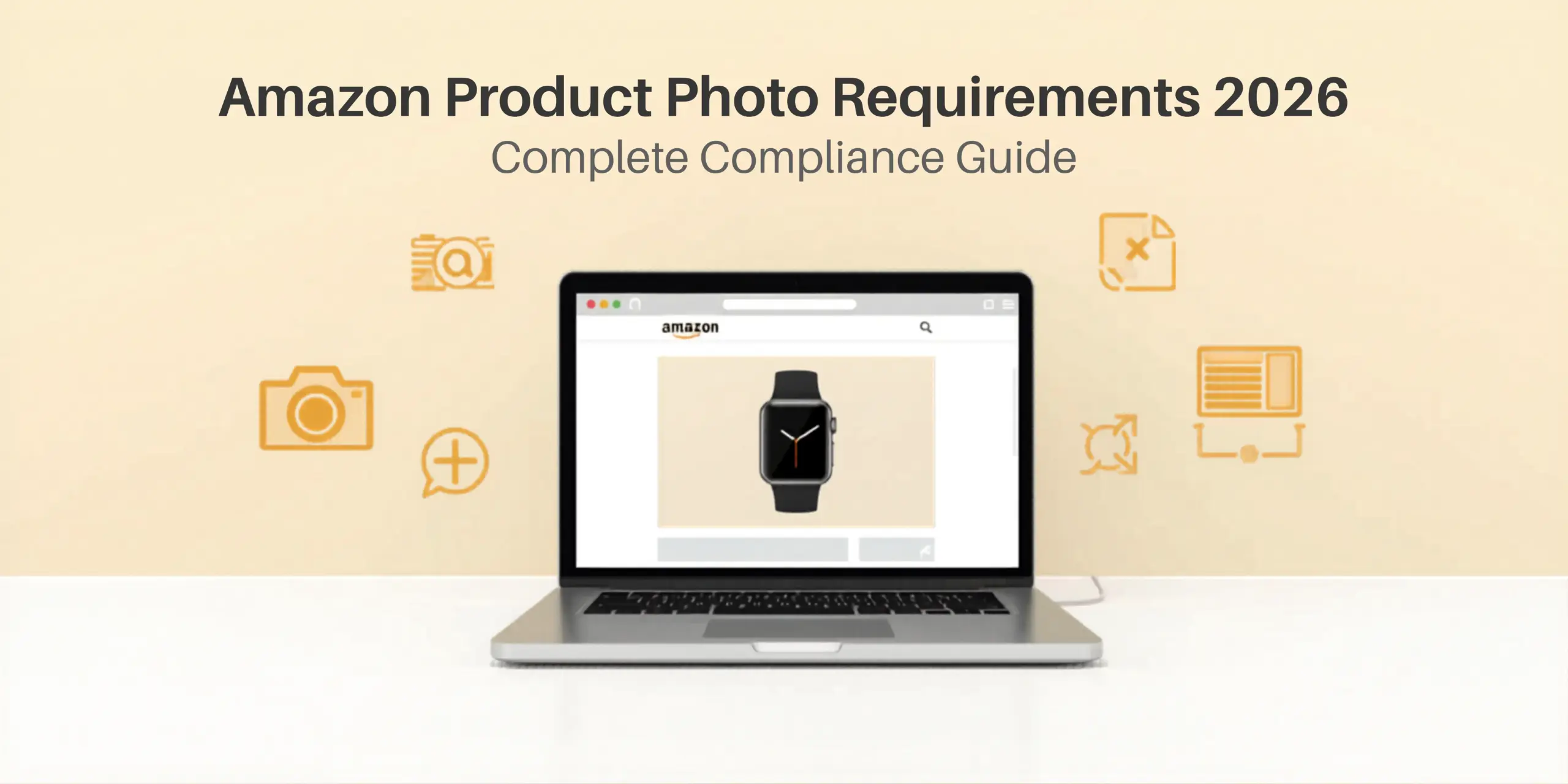
If you sell on Amazon, your product photographs are not just helpful to customers; they are also required by law. Amazon has rigorous rules for images in every category. If you don’t follow them, your listing may be hidden, lose exposure, or even be removed from search results. Knowing exactly what Amazon wants in 2026 is the difference between a listing that sells and one that gets lost for Amazon sellers, FBA businesses, and product photographers.
This article tells you all you need to know, including the rules for the main picture, the size and resolution requirements, the best practices for supplementary images, the regulations for each category, and the most common reasons Amazon hides listings. It also talks about how professional photo editing, when done correctly, maintains every picture completely legal without lowering the quality.
Photodotedit works with sellers on Amazon and other e-commerce sites all over the world to make pictures that look great and meet Amazon’s technical standards. The crew does everything from removing backgrounds to optimizing complete images for Amazon listings, starting at $1 per image.
Amazon Main Image Requirements: The Rules That Get Listings Suppressed
The main product image is the single most regulated element of any Amazon listing. It is the image that appears in search results, on the product detail page, and in sponsored ads. Amazon holds it to the highest standard, and any deviation from the rules can trigger automatic listing suppression.
Here is what Amazon currently requires for main product images:
- The background must be pure white (RGB 255,255,255)
- The product must fill at least 85% of the image frame
- No additional text, logos, watermarks, borders, or graphics are permitted
- The image must show the actual product being sold, not an illustration or placeholder
- No lifestyle elements, models (in most categories), or props that are not part of the product
- The product must not be shown inside packaging unless the packaging itself is the product
These rules are enforced through both automated scanning and manual review. Amazon’s algorithms are increasingly capable of detecting off-white backgrounds, small watermarks, and frame coverage that falls short of the 85% threshold. Listings that fail these checks are flagged and suppressed without warning.
Pure White Background (RGB 255,255,255) Requirement Explained:
Most merchants are surprised by the white background rule. Photographing your goods against a white wall, sheet, or lightbox isn’t enough. The camera sensors and lighting circumstances make the background look white, yet the pixel data indicates a shade of gray, cream, or warm white.
The backdrop must be RGB 255,255,255, the highest white value. Anything below RGB 245,245,245—which appears white on screen—will still appear off-white and may suppress.
Post-processing is the only way to guarantee an RGB 255,255,255 backdrop. Professional editors replace the backdrop with a solid white fill that meets Amazon’s standards. For complex edges, see-through portions, glass, or little details like jewelry chains or fabric fringe, auto-remove tools or basic editing software usually don’t work.
Photodotedit replaces backgrounds on all items, including those with hard borders, with confirmed RGB 255,255,255 backdrops suited for Amazon upload.
Image Size and Resolution Requirements
Amazon provides both minimum and recommended sizes for images. Getting these correctly affects not only compliance but also how your product looks when zoomed in, which has a direct effect on consumer trust and conversion rates.
Minimum and Recommended Dimensions
- Minimum image size: 500 pixels on the longest side (this meets the upload threshold but is not recommended)
- Minimum for zoom functionality: 1000 pixels on the longest side
- Recommended size: 1600 pixels or more on the longest side
- Maximum file size: 10MB per image
- Accepted formats: JPEG (preferred), PNG, GIF, and TIFF
Zoom activates when the longest side of the picture is 1000 pixels. Amazon recommends 1600 pixels or higher because zooming closer on a product indicates interest. Pixelated zoom views are a major reason consumers abandon baskets on product pages.
For practical reasons, most professional product photographers shoot at resolutions over 2000 pixels on the longest side. Sellers frequently worry about editing rather than photo resolution. Cropping, changing the backdrop, or resizing can lower resolution. Thus, editing is as crucial as shooting.
Aspect Ratio and Frame Coverage
Amazon allows square images (1:1 ratio) in most categories. Square frames are great for matching search results and detail pages.
The 85% frame coverage rule requires that the product, not the background, take up at least 85% of the photograph. Merchants who trim photos too much or leave a lot of white space can make mistakes. A skilled editor can adjust the product’s size, shape, and canvas position to meet this need.
Secondary Image Requirements and Lifestyle Shots
Amazon has stricter rules for the primary picture than for subsidiary photos, which can be far more imaginative. The image carousel on a product detail page shows these extra product photographs, which are usually in positions 2 through 9.
What Secondary Images Can Include
- Lifestyle photography showing the product in use
- Close-up detail shots highlighting textures, materials, or features
- Infographic images with text and callouts describing features or dimensions
- Comparison charts or size guides
- Packaging shots
- 360-degree or multi-angle views
Secondary photos don’t need a white backdrop. They can use real-life places, colorful backgrounds, stylized environments, or graphic overlays. This is where vendors may create a story about their goods, build trust, and address the questions that customers most often have before they buy.
What Still Applies to Secondary Images
Even in secondary slots, Amazon prohibits:
- Nudity or offensive content
- Images that misrepresent the product or its size
- Contact information, URLs, or promotional messaging like “sale” or “free shipping”
- Watermarks or third-party logos
Well-made supplementary images make conversion rates go up a lot. A major picture makes someone click. Secondary images are what make people buy after they click. Sellers who want to get the most out of their listings must invest in both compliance-ready main photographs and engaging secondary images. This is not an option; it is a business imperative.
Category-Specific Rules
In addition to the general regulations that apply to all products, Amazon has extra rules for certain types of products. These are the ones that most often surprise sellers, especially when they are moving into new areas.
Apparel and Clothing
For apparel, Amazon has distinct rules depending on whether the item is for adults or children.
- Adult clothing must be displayed on a model or on an invisible mannequin (ghost mannequin). Flat-lay photography is not permitted for main images in adult apparel.
- Children’s clothing must be displayed on a flat lay or on a hanger. Models are not permitted for children’s apparel main images.
- The product must fill the frame adequately. A loose, baggy presentation that hides the garment’s shape is not acceptable.
dult clothing stores that don’t want to utilize live models usually use the ghost mannequin technique. This technique involves post-processing to remove the mannequin from within a garment to make it look like it’s hollow. It illustrates how the clothing fits and hangs without having to pay for model photos for each SKU. Photodotedit offers ghost mannequin editing as a separate service, starting at $1 per image as an extra in its Standard package.
Jewelry
Jewelry is one of the most technically demanding categories for product photography and editing.
- Main images must show the actual product against a white background
- Mannequin hands or necks are permitted, but must be invisible or clearly secondary to the jewelry itself
- Reflections and shadows must look natural, not artificial
- Scale indicators are helpful in secondary images because buyers frequently struggle to judge size from photos alone
High-resolution photographs, accurate clipping paths, and natural shadows are essential for jewelry photography. Jewelry’s transparent, bright, or metallic surfaces reflect background color and light. A white gold ring might look yellow, and a clear gemstone blurry if edited improperly. This precision requires expert editing tools and skills to fix colors and alter backgrounds.
Electronics
Electronics main photos must solely depict the product. Cords, attachments, and packaging should only be displayed if they are essential to the description. Device screen displays must be blank or clearly fake to avoid deception.
Bundles or kits can feature all of the things in the primary image, but the main product should be the focus.
Common Reasons Amazon Suppresses Product Listings
Amazon can take down a listing at any time, even after it has been up and doing well. These are the most common reasons for image problems:
- Off-white background: The most typical cause is an off-white background. As was said before, near-white is not the same as white. If the RGB values on any channel are less than 255,255,255, suppression will happen.
- Product occupying less than 85% of the frame: This happens a lot when sellers post photographs that are meant for their own website but don’t resize them to fit Amazon’s frame coverage standard.
- Text or graphics on the main image: Amazon doesn’t allow any text, graphics, or other things on the main image, even if they are small. This includes promotional text, size callouts, brand logos, or anything else.
- Watermarks: If the primary image has any kind of watermark, even a minor copyright indication, it will be taken down.
- Blurry or low-resolution images: Images that are less than 1000 pixels on the longest side, or images that are theoretically big but look soft because of bad photography or too much compression, will be highlighted.
- Category rule violations: Common category-specific breaches include showing clothes as flat lay when a model is needed and showing devices with accessories that aren’t included.
- Inaccurate product representation: Images that show a different variety (color, size, configuration) from the one being sold on that specific ASIN will be hidden.
Suppression doesn’t usually come with a full notification. Sellers frequently find out when their listing goes missing from search results or their sales drop drastically. Regularly checking the Manage Inventory area in Seller Central for suppression notifications is a vital aspect of keeping your listings up to date.
How Professional Editing Ensures Amazon Compliance
Most sellers can’t consistently meet Amazon’s picture criteria across dozens or hundreds of SKUs with just basic editing tools or on their own without setting aside time and getting the right skills.
Professional editing of product photos meets all regulatory requirements directly:
- Background removal and replacement: A good clipping path or masking technique gets rid of the original backdrop neatly, even around fine edges, and puts in a confirmed RGB 255,255,255 background. One-click tools can’t always do this right, especially for complicated products.
- Frame coverage adjustment: Editors can change the size and position of the product on the canvas to make sure it fills 85% of the frame without changing the product’s proportions.
- Resolution optimization: Images are exported at the right size for Amazon’s zoom feature, with the longest side being at least 1600 pixels and the file size being less than 10MB without any noticeable loss of quality.
- Shadow and reflection work: After the background is changed, natural shadows are added or restored to keep the look genuine and grounded. Reflections are added to glass and shiny things when they need them.
- Color correction: Having the same color for all product versions and showing the real color of the product accurately stops the category violations that happen when listing photos don’t match.
- Ghost mannequin and apparel editing: For sellers of clothes, ghost mannequin editing makes the hollow 3D look that adult clothes main photographs need, without the ongoing cost of hiring models to take pictures.
Photodotedit offers all of these functions in one process. Customers send in their original product photos, tell us what they want, and any instructions that are special to their category. They then get modified photos back within 24 to 48 hours, depending on the plan. The service offers free changes until the result matches the client’s exact needs, so there is no risk in sending a first batch. New clients can also provide a sample picture for a free trial edit before they pay for anything.
The Business plan lets sellers manage up to 3,000 photographs every month at a cost of $2 per image. It also comes with specialized customer service and a 24-hour response time. The Enterprise plan comes with unique pricing and a faster way to exchange files for studios and photographers who operate with a lot of clients.
Get Amazon-Compliant Product Photos Edited
Amazon has strict rules for images, and they are modified often. It’s not a one-time fix to keep your listings compliant for every SKU. It’s an ongoing exercise. The quality and conformity of your photographs directly affect how well your listings do in search and how shoppers react when they get to your product page, whether you’re introducing your first product or maintaining a catalog of hundreds.
Photodotedit is a company that edits product photos for people who sell on Amazon. The staff takes care of all the technical needs, like removing backgrounds, editing ghost mannequins, correcting colors, and improving quality, so your photographs fit Amazon’s criteria and look professional at the same time. Editing costs $1 per image, and new clients can get free sample editing and unlimited free revisions until the results meet their expectations.
Send us your first picture for a free edit and experience how your own catalog appears with conforming, high-quality Amazon product photos.
What background color does Amazon require for main product images?
Amazon says that the background must be pure white with an RGB value of 255,255,255. Amazon’s automatic review system will still designate backgrounds that look white but have lower RGB values as non-compliant.
What is the minimum image size for Amazon product listings?
No. The main image of the product on Amazon must show simply the product against a pristine white background, with no models, lifestyle aspects, or props that are not part of the product being sold.
Can I use lifestyle images as my main product photo on Amazon?
No. The main image of the product on Amazon must show simply the product against a pristine white background, with no models, lifestyle aspects, or props that are not part of the product being sold.
Why did Amazon suppress my listing even though my background looks white?
On screen, a background can look white, but at the pixel level, it may not match Amazon’s RGB 255,255,255 criteria. The way white looks on camera, in post-processing, and on a monitor all change how the color data reads. The only way to be sure that compliance is met is to use professional backdrop replacement.
What is the ghost mannequin technique, and when is it required?
The ghost mannequin technique is a way to edit a picture after it has been taken. It eliminates a mannequin from inside a piece of clothing, leaving a hollow 3D shape that demonstrates how the apparel fits without a model or form. For merchants who don’t employ live model photography, this is the best way to show off adult clothing on Amazon.
Does Amazon allow watermarks on product images?
No, Amazon does not allow any form of watermark on product photographs, including little copyright marks. If you do, your listing will be hidden.