
A listing’s photographs may make or break it in today’s real estate market. Before setting even a single showing, buyers browse through dozens of houses on their phones, and the pictures they see in those initial seconds decide whether or not your listing is clicked. Because of this, real estate photo editing becomes an essential component of the marketing process rather than a final touch.
This article is intended for real estate photographers, agents, and property marketing teams who wish to learn what professional editing entails, which approaches are most important, and how outsourcing to a specialized service like Photodotedit can alter the way you present your work to clients. The material that follows provides you with a comprehensive picture of what the process looks like in 2026, regardless of whether you are editing your own photos or searching for a trustworthy post-production partner.
Why Real Estate Photo Editing Is Non-Negotiable in Today’s Market
In the past, real estate agents could choose whether or not to hire a professional to retouch their photos. Not anymore.
Listing sites are more competitive now, and most purchasers start their search online. Properties with professionally altered photographs get more views, more inquiries, and sell faster than properties with raw or poorly processed photos. The data from different price ranges and market categories always backs this up.
Raw real estate photography rarely shows how a space really feels. The way light affects human eyes and camera sensors is different. Pictures taken inside near windows look too bright or too dark. Colors alter when the lights are on. Wide-angle lenses change the way architectural lines look. Everything that the photographer saw in person looks uninteresting on a screen.
Professional editing fixes all of this. It gets rid of clutter that can be distracting, fixes the camera’s light balance, and shows the property in its best light. For agents, stronger listings are the direct result. For photographers, this means taking pictures that customers will remember and come back to.
For more than 10 years, Photodotedit has been editing real estate photos for photographers, brokers, and property marketing teams in the US, UK, Australia, and other countries. There are now many more ways to edit, and this course gives a useful summary of all the primary ones.
HDR Blending: Merging Exposures for Perfect Interior Shots
What HDR Blending Is:
High Dynamic Range is referred to as HDR. It describes the process of taking several exposures of the same scene at various brightness levels and then combining them in post-production to produce a single, well-balanced image in real estate photography. Three to seven exposures, ranging from underexposed to overexposed, could make up a typical bracket.
Why It Matters for Interiors:
One particular problem with interior photography is that the camera cannot properly expose for both a bright window and a darkened room interior at the same time. When you aim toward the room, the windows turn completely white. The room darkens if you aim for the windows.
This is resolved via HDR mixing, which combines the appropriately exposed outdoor vista from one photo with the appropriately exposed room from another. As a result, the interior and window view appear natural and well-lit, much as a person standing in the room would.
What to Expect from a Good HDR Edit:
A well-done HDR edit should appear entirely organic. Images with a typical over-processed, surreal appearance, complete with halos around edges and increased contrast, are the result of poor HDR processing. Expert editing services use Photoshop’s masking techniques to manually blend exposures, giving them exact control over where each exposure is applied. In Photodotedit’s Extra Level service, which involves manual image and exposure editing and masking, this is routine procedure.
Sky Replacement: When and How to Use It Ethically
The Practical Case for Sky Replacement:
The weather is beyond the control of photographers. A shoot that is planned weeks in advance can take place on a cloudy, gray day, which would take the color out of outdoor photos and make a lovely house appear lifeless. Editors can replace a flat or stormy sky with a bright blue sky or an eye-catching cloudy sky that is more appropriate for the property and time of day.
Regardless of the real weather, the outcome is an outdoor photo that appears tidy, welcoming, and well-lit.
Ethical Use of Sky Replacement:
When it comes to sky replacement, the moral line is clear. It’s common practice in the industry to swap out a gray sky with a blue one. Changing the surrounding environment in a way that distorts the property’s real setting—for example, replacing a sky while also demolishing nearby buildings or creating an imaginary view—crosses the line.
Sky replacement is regarded as a normal and expected component of real estate photo editing since it improves the property’s natural appearance without distorting it. This is how the majority of buyers, agents, and listing platforms function.
Sky Replacement at Photodotedit:
There are two options for replacing the sky: Standard and Extra. While the Extra level uses Photoshop techniques for more complicated situations where lighting uniformity between the new sky and the property outside needs to be manually adjusted, the Standard level uses Lightroom to handle simple sky swaps.
Window Pull: Balancing Interior Exposure with Exterior View
What Window Pull Means:
One of the most prevalent issues in interior real estate photography is resolved by a particular editing technique called window pull. Windows become overexposed brilliant areas with little discernible detail when a camera exposes for the interior of a room. Compositing a properly exposed outdoor view into the blown-out window area of an inside picture is known as window pull.
In theory, this is comparable to HDR blending, however it applies only to windows rather than the full image. The objective is to create a single image that depicts the room and what can be seen via the window.
When to Use It:
When a property’s view—such as a garden, a view of the ocean, the skyline, or an appealing outdoor area—is a selling point, window pull is particularly valuable. Additionally, it is helpful when an otherwise powerful interior shot is diminished by blank white windows.
HDR Bracketing with Indoor Window Replacement, which manages window pull as part of a thorough interior editing workflow, is part of Photodotedit’s Extra Level service.
Virtual Twilight: Turning Daytime Shots into Stunning Dusk Images
The Appeal of Twilight Exteriors:
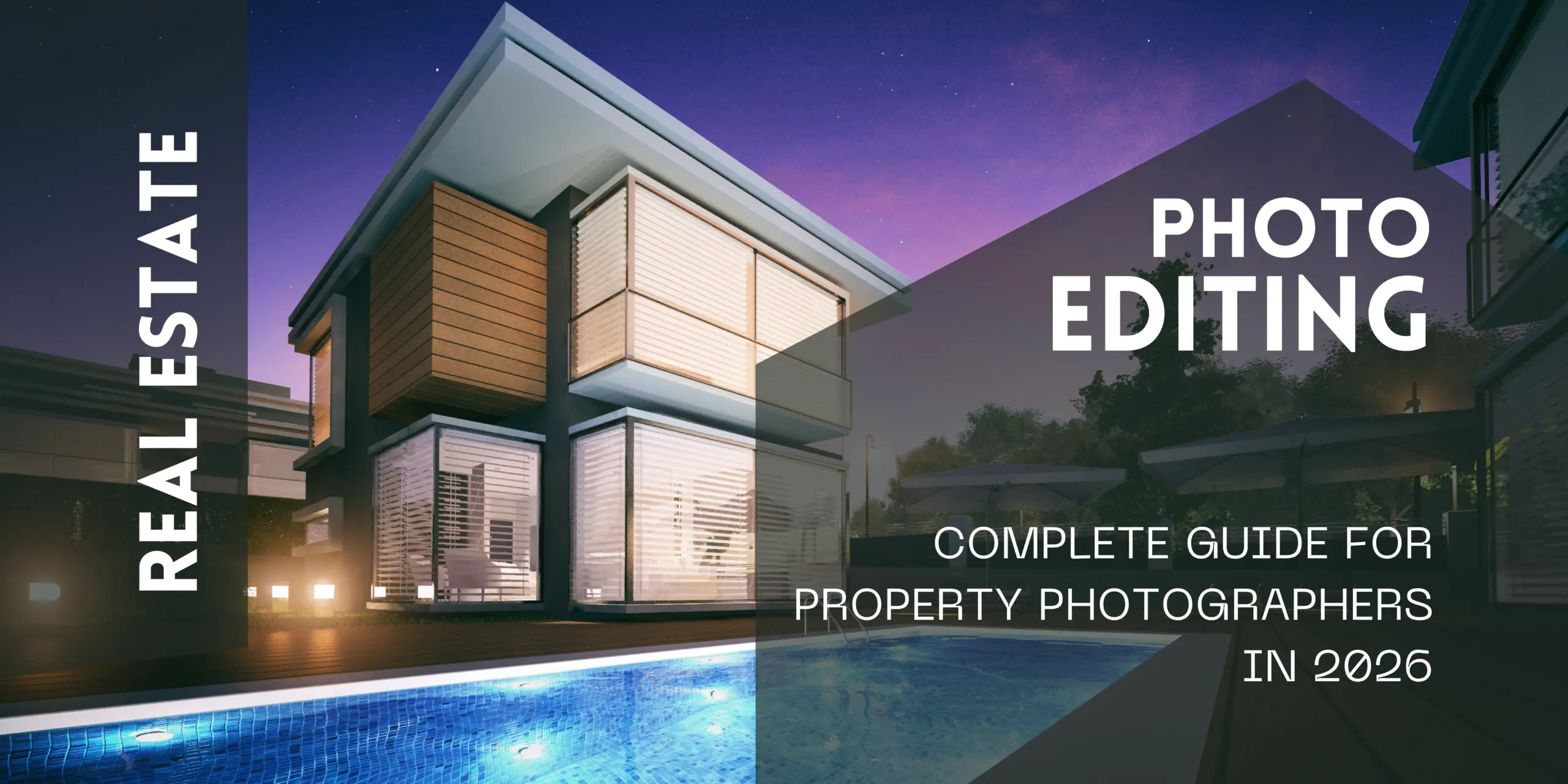
The perception of exterior property pictures is significantly influenced by twilight or dusk photography. Warm interior lights visible through windows, a deep blue sky, and the gentle shift of evening light combine to give a feeling of coziness and appeal that is frequently unmatched in daytime photos.
It’s challenging to shoot at true twilight. Because there is only a brief window of useable natural light, scheduling a crew at that precise time adds logistical complexity, and the outcomes are highly dependent on seasonal light timing and cloud cover.
Day-to-Dusk Conversion:
In post-production, editors can create a convincing twilight image from a daytime outside shot by using virtual twilight, often known as day-to-dusk conversion. The image’s general color temperature is changed to represent nighttime conditions, external lighting is mimicked, inside lights are added or improved, and the sky is replaced with a dusk gradient.
For the technique to appear convincing, a significant amount of manual Photoshop labor is needed. Inconsistent light direction, color temperature, and shadow behavior make poorly done day-to-dusk adjustments appear unnatural. Photodotedit’s Extra Level service offers professional-grade day-to-dusk editing, which yields pictures that are hard to tell apart from a real twilight session.
Item Removal: Decluttering Rooms in Post-Production
Why Item Removal Is Necessary:
Photographs of occupied properties are rarely as clear as those of staged ones. An otherwise excellent shot can be cluttered with personal belongings, poorly photographed furniture, obvious cables and cords, cleaning supplies, and other stuff. It’s not always feasible to ask vendors to take everything out before a photo session, and sometimes the picture is shot before the problem is discovered.
Using content-aware fill and manual Photoshop retouching techniques, editors can digitally remove elements from a scene during post-production. Without needing a reshoot, the outcome is a room that appears cleaner and more roomy.
What Can and Cannot Be Removed:
Most of the time, simple items like garden hoses, power lines, trash cans, small appliances, and personal images can be removed with clean results. It requires more effort and expertise to recreate the background behind larger objects. For instance, the editor must recreate the wall, floors, and surrounding areas with convincing realism when removing a huge piece of furniture from a scene.
In addition to dust and rubbish editing, Photodotedit’s Extra Level service includes cord and item removal as part of its regular workflow.
Virtual Staging: Furnishing Empty Rooms Digitally
The Problem with Empty Rooms:
Marketing vacant rooms is challenging. Buyers find it difficult to comprehend the size of the room, how it flows, and how it can appear as a lived-in house without furnishings. Staged residences sell more quickly and for more money than unstaged ones, according to numerous studies. Physical staging, however, is costly, time-consuming, and unfeasible for vacant properties that must be marketed right away.
How Virtual Staging Works:
In virtual staging, photorealistic furniture, décor, and finishing touches are added to photos of empty rooms using computer graphics and compositing. In order to make the furniture seem to fit in, it is rendered to match the room’s scale, perspective, and lighting.
It should be challenging to tell the difference between a photograph of a physically staged environment and a well-executed virtual staging image. The editing team’s access to a high-quality 3D furniture library, the quality of the compositing work, and the attention to lighting consistency and shadow correctness all affect the final product’s quality.
One of Photodotedit’s real estate services is virtual staging. Virtual staging offers a good return on investment for agencies and owners who need to sell unoccupied properties without having to pay for physical staging.
Disclosure Considerations:
Virtually staged photographs must be declared as such by the majority of listing platforms and industry groups. With just a label on the picture or a remark in the listing description, this can be easily implemented. Virtual staging is understood by buyers, who typically view it favorably as a useful visualizing tool.
Color Correction for Artificial Lighting
The Mixed Lighting Challenge:
Mixed light sources are nearly usually used in real estate interiors. A room may simultaneously have natural daylight coming through windows, cool LED recessed lighting overhead, and warm tungsten lights in lamps. The color temperature of each light source varies, and cameras find it difficult to balance them all at once.
Without correction, the outcome is frequently a patchwork of color casts: blue tones next to windows that contrast with the room’s warmer interior, green shadows from fluorescent lights, or yellow walls that are actually white.
What Color Correction Involves:
In order to neutralize uneven color casts, professional color correction for real estate entails first white balancing the image for the prevailing light source and then carefully modifying particular regions of the frame. Skin tones in any occupied areas are adjusted to appear natural, surfaces that should be neutral white or gray are rectified to read as such, and the entire image is brought into a consistent color space.
There is more to this work than just one global white balance slider. To address different parts of the same image, it requires precise masking, targeted color tweaks, and occasionally several processing runs. These adjustments are made by Photodotedit at both the Standard and Extra editing levels.
Vertical and Perspective Correction for Architecture
Why Architectural Lines Go Wrong:
Because they capture more of a room in a single picture, wide-angle lenses are common in real estate photography. But when the camera is tilted up or down, they also cause vertical lines to converge and generate lens distortion, especially at the frame’s corners. When a structure is photographed from street level using a wide-angle lens, the vertical walls will clearly taper toward the top of the picture, giving the impression that the building is leaning backwards.
This type of distortion makes a property appear less substantial than it actually is and is instantly unprofessional.
Correcting Perspective and Distortion:
The barrel or pincushion distortion caused by the lens itself is corrected via lens distortion removal. Using perspective warp tools in Photoshop or transform controls in Lightroom, perspective correction corrects the convergence of vertical and horizontal lines produced by camera angle.
The objective is to create a picture where the space’s proportions read correctly, the floors are truly horizontal, and the walls are truly vertical. More intricate architectural adjustments are handled at the Extra Level of Photodotedit, which also covers lens distortion reduction and vertical and horizontal straightening at the Standard Level.
Drone and Aerial Photo Editing for Real Estate
What Aerial Photography Adds to a Listing:
For larger houses, homes on vast lots, properties with noteworthy surroundings, and commercial real estate, drone photography has become a standard component of real estate marketing. In a manner that ground-level photography cannot, aerial photos create context by demonstrating the property’s relationship to other buildings, streets, water features, green space, and the community.
The most captivating picture in a listing could be a powerful aerial photo taken on a good day. The total package is diminished by a poor one or one that hasn’t been adjusted for color, horizon alignment, and general consistency with the ground-level photographs.
Aerial Editing Techniques:
Many of the same methods used in ground-level real estate editing are also employed in aerial photo editing, but they are applied to distinct problems. Because air haze gives photos taken from height a blue or gray tint, color correction for aerial views frequently requires taking this into consideration. Even if the drone wasn’t quite horizontal during the photo, horizon correction makes sure the picture seems level.
Aerial color fade correction, aerial drop pin additions, aerial highlighting of particular property locations, and aerial editing combinations for complex requirements are all included in Photodotedit’s Extra Level service.
Turnaround Expectations: 24-Hour Delivery for Real Estate Pros
Why Turnaround Time Matters in Real Estate:
The real estate market moves swiftly. To keep up with market timing, agents frequently require listing photographs retouched and ready within 24 to 48 hours of the photo session. In that setting, a photographer who produces retouched photos in five to seven days is a liability. The agents who collaborate with someone who regularly delivers within 24 hours gain a competitive edge.
Turnaround time is more than just a customer service metric for photographers operating a volume-based real estate firm. It’s an operational limitation. You will always have a backlog if you photograph four properties a week and editing takes three days. Your workflow remains tidy, and your clients remain happy if editing is completed the next day.
What Photodotedit Guarantees:
Orders for real estate photo editing can be delivered around-the-clock by Photodotedit. The normal procedure for real estate volumes is covered by this assurance. Larger orders or those that call for more intricate editing tasks, like comprehensive day-to-day conversions or complete virtual staging packages, may need more time, which is disclosed in advance.
The 24-hour turnaround is applicable without sacrificing quality. To ensure that quality maintains that pace for the particular kind of work you require, it is worthwhile to request a sample edit prior to submitting your first purchase.
Pricing: Cost Per Image vs Time Saved
Understanding the Real Cost of In-House Editing:
Because the cost of outsourcing each image seems like an additional investment, many photographers and agents first edit their own real estate photos. When you appropriately account for time, the computation is altered.
Professional editing of a typical real estate gallery with 30 to 50 photos usually takes three to six hours. In addition to shooting, client communication, marketing, and business administration, a photographer who shoots two or three properties a week could spend up to eighteen hours editing each week. That editing time is significantly more expensive than outsourcing at any fair hourly rate for a professional photographer’s time.
Photodotedit Pricing Structure:
Photodotedit offers two service levels for its real estate editing costs.
White balancing, image sharpening, vertical and horizontal straightening, blemish removal, lens distortion removal, brightness and contrast adjustment, sky replacement, water enhancement, tone adjustment, dust spot removal, HDR bracketing with indoor window replacement, cropping, and resizing are all included in the Standard Level, which costs between $3.00 and $5.00 per image. This tier accepts JPG and PNG files and is processed in Lightroom.
Lawn enhancement, TV screen replacement, flash reflection removal, fireplace fire addition, photographer reflection removal, burned-out lightbulb fixes, shadow removal, window enhancement, cord removal, manual editing and masking, carpet and curtain smoothing, dust and garbage editing, day-to-dusk conversion, aerial editing, color changing, and item removal are all included in the Extra Level, which costs between $5.00 and $10.00 per image. RAW, JPG, PNG, and TIFF files can be processed manually in Photoshop at this tier.
Contacting Photodotedit directly for a personalized price based on your monthly volume is worthwhile for photographers who require real estate photographs edited, starting at $1.50 per image on volume packages.
Revisions:
Until the change satisfies the predetermined style criteria, Photodotedit offers free, limitless modifications. This policy does not have a set number of rounds. Corrections are made at no extra cost if the delivered work does not match the specifications at the time of the order. This is important for real estate editing because maintaining a consistent look throughout a gallery requires sporadic adjustments.
How to Submit Images and What to Expect
File Formats and Submission:
JPG and PNG files can be edited at Standard Level. RAW, JPG, PNG, and TIFF files can be edited with Extra Level. The Extra Level is the right grade if you are shooting RAW and require complicated manual labor or HDR blending.
Giving the editing team precise style references when submitting a new order makes it easier for them to comprehend your preferences. It is much less likely that you will need adjustments on the initial delivery if you have previously updated examples that reflect the desired look.
Communication and Support:
For quick answers on pricing, order status, and style inquiries, contact Photodotedit via email at [email protected] or [email protected], over the phone at +91-8130136092, or over WhatsApp. The WhatsApp connection in particular makes it feasible to confirm the delivery schedule without delays for photographers who are under pressure to meet listing deadlines.
For individuals who require a physical point of contact, the Gurugram office address is D-120, Saraswati Enclave, Sector 10B, Sector 37, Gurugram, Haryana, 122004, India.
Real Estate Photo Editing from $1.50/image
Editing real estate photos is not a luxury feature for high-end listings. For any property to be offered competitively in 2026, it is a prerequisite. The difference between a listing that is skipped and one that has a showing scheduled is the difference between an unprocessed outside photo taken on a gloomy day and a professionally altered image with accurate color, a replacement sky, and corrected perspective.
There is a compelling practical argument for photographers to outsource this labor. Saving time on editing allows you to film more properties, develop relationships with clients, and manage a long-term business. Working with a photographer who provides professionally edited photos in less than a day is a tangible competitive advantage for agents and property marketing teams.
With free unlimited revisions, 24-hour delivery, and prices starting at $1.50 per image, Photodotedit offers real estate photo editing at both the Standard and Extra tiers. The free trial edit is a great place to start if you want to preview how the work appears before placing an order. Submit your photos, evaluate the outcomes, and decide what to do next.
What is included in real estate photo editing?
HDR blending, sky replacement, window pull, day-to-dusk conversion, item removal, virtual staging, color correction, perspective correction, lens distortion removal, and aerial photo editing are all examples of real estate photo editing. The editing tier chosen determines the particular services that are offered.
How long does real estate photo editing take?
For regular real estate orders, Photodotedit promises 24-hour delivery. Orders that are complicated or have a large volume may take longer; deadlines are guaranteed at the time of submission.
Is sky replacement ethical in real estate photography?
In real estate photography, it’s common practice to swap out a cloudy or gloomy sky for a clear or appealing one that doesn’t distort the property. Replacing environmental components that significantly impact the property’s surroundings or value is misrepresentative and needs to be avoided.
What is virtual staging and how realistic does it look?
Photographs of empty rooms are staged using computer-generated furniture and décor. Professional staging produces photorealistic results that are hard to tell apart. Virtually manufactured photographs must be disclosed as such on the majority of platforms.
Can I get a sample edit before placing a full order?
JPG and PNG are accepted at the Standard Level. RAW, JPG, PNG, and TIFF are supported by Extra Level.
Is there a free trial available?
Indeed. For new customers, Photodotedit provides a free trial edit. The easiest method to determine whether the service meets your standards for quality and style is to submit a collection of sample photos and have them edited before committing to a full order.