

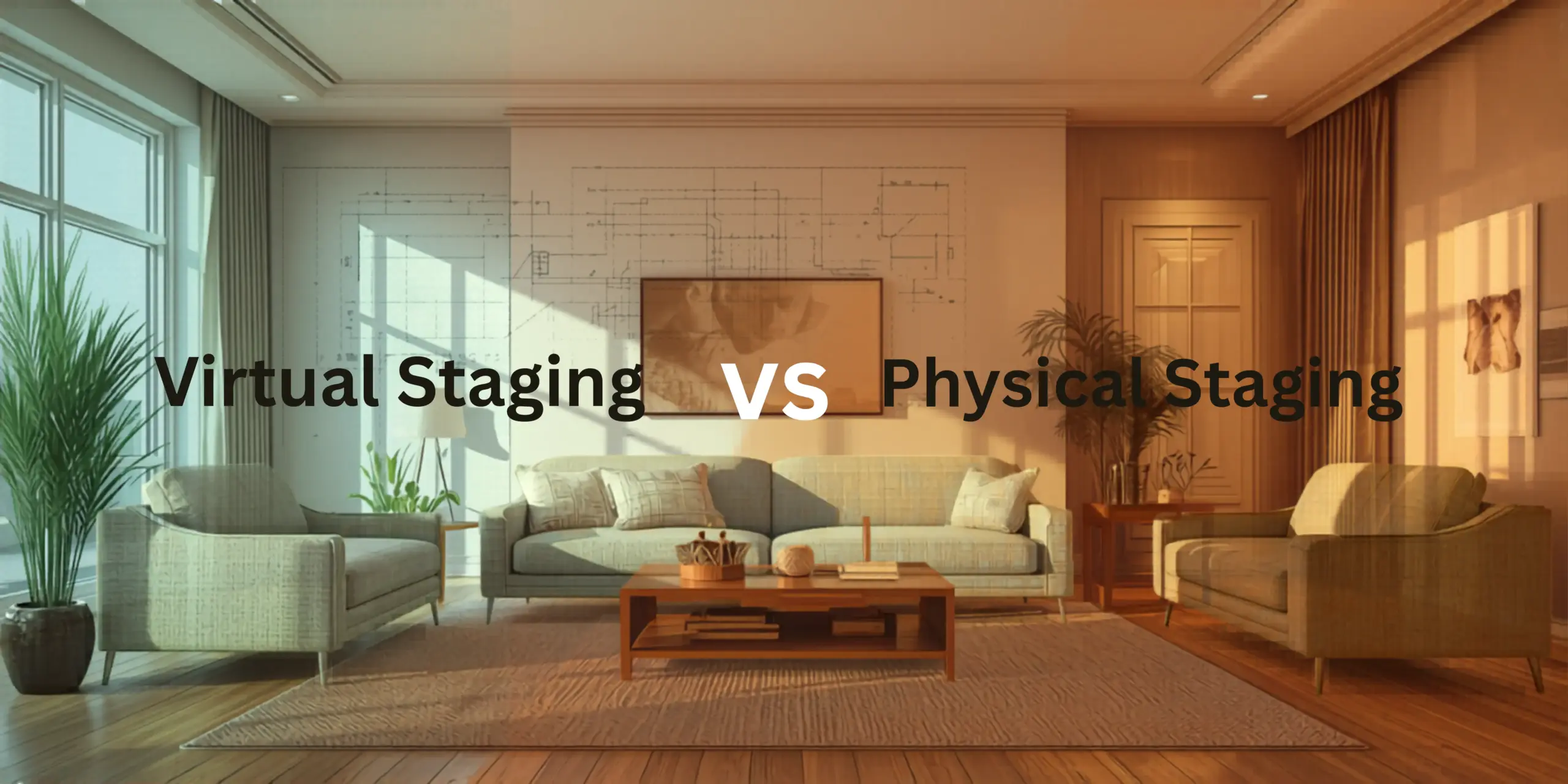
In today’s market, a property’s internet appearance is the most important factor when selling it. The majority of buyers start their search on listing platforms, and whether they click through or scroll past depends on the quality of the photographs. This is where staging comes into play, and a developing discussion is changing the way real estate agents handle listings.
For many years, physical staging has been the norm in the profession. The more recent option is virtual staging, which uses computer rendering and photo manipulation. Both seek to achieve the same objective, which is to transform an unoccupied or unsightly area into a house that a potential buyer can envision living in. However, they are very different in terms of practical logistics, cost, speed, and flexibility.
This essay explains the actual distinctions between virtual and physical staging in terms of every aspect that matters to photographers, real estate brokers, and property developers. This guide provides you with the honest, useful comparison you need if you’re attempting to determine which strategy is best for your listings or if combining both is the appropriate decision.
In order to help agents and photographers obtain listing-ready photos without the delays and expenses associated with physical staging, services like Photodotedit have collaborated with real estate professionals to give virtual staging as part of a larger real estate picture editing workflow. Determining where to focus your efforts will be made easier if you know what each strategy actually entails.
What Is Physical Staging?
The process of furnishing and decorating a house with actual furniture, décor, artwork, rugs, and accessories before photography and showings is known as physical staging. A qualified staging business evaluates the area, chooses suitable furniture from their stock, moves everything to the home, arranges it, and then comes back to take it down once the listing period is over.
During in-person showings, the objective is to assist purchasers in developing an emotional bond with the location. A well-staged house has a warm, inviting, and aspirational vibe. Through careful furniture placement, it conveys scale, illustrates how rooms work, and conceals architectural flaws.
Physical staging works very well when:
- There will be regular in-person showings of the property.
- The lifestyle presentation has a tremendous impact on the target consumer group.
- The home’s peculiar layouts benefit from furnishings that shows how it is used.
- To justify premium pricing, luxury properties must have a high-touch presentation.
Cost and logistics are the drawbacks. Delivery timetables, setup teams, and removal times must all be coordinated for physical staging. Additionally, it mandates that the house be kept staged for the life of the listing, which entails continuing furniture rental costs.
What Is Virtual Staging?
Professional editors utilize software to add photorealistic furniture, décor, and finishes to photos of empty or sparsely furnished rooms as part of a digital home staging approach called “virtual staging.” Couches, dining tables, artwork, lights, plants, and other interior components that give the room the appearance of being fully furnished are added to the raw property photo through editing.
High-quality pictures of vacant rooms are the first step in the process. After that, the photos are uploaded to a picture editing service, where editors digitally arrange furniture and décor to fit the architecture, scale, and desired aesthetic of the space. The final product appears to be an interior that has been expertly set and photographed.
Real estate virtual staging has expanded quickly in tandem with the trend of online property searching. Digitally arranged photos can perform the same emotional work as real staging at a fraction of the cost, as most buyers base their initial impressions on listing photos rather than in-person visits.
Virtual staging is effective for:
- New development and vacant investment properties
- Online listings are the main way that properties are marketed.
- Sellers who are unable to pay for complete physical staging
- Agents overseeing several postings at once
- Renovations where it is not feasible to physically stage
Cost Comparison: Virtual Staging Saves 90%+
This is where there is the biggest difference between the two methods.
Physical Staging Costs
The cost of staging a whole house normally falls between $1,500 to $5,000, depending on the size of the house, the number of rooms being staged, and the staging company’s pricing structure. This usually includes a one-time consulting price, monthly fees for renting furniture, setup and delivery costs, and a removal fee at the end of the given period.
It might cost anything from $3,000 to $6,000 to stage a mid-sized three-bedroom home for two months. Luxury homes with more rooms and more complicated staging needs could make that number go up a lot.
Virtual Staging Costs
The price of virtual staging for each image normally falls between $25 and $150, depending on how complicated the space is, how good the service is, and how many pictures are in the order. A full home listing with six to eight rooms may cost between $150 to $600, which is a lot less than what it costs to stage a property in person.
Photodotedit is a company that edits real estate photos. One of the things it does is virtual staging, which is priced so that agents with a lot of listings can afford it. With the per-image concept, you only pay for what you need; there are no monthly fees, leasing fees, or removal expenses.
The Bottom Line on Cost
When it comes to getting the same look in listing images, virtual staging is usually 90% or more cheaper than real staging. That difference in price is essential for real estate agents who manage multiple residences or don’t have a lot of money.
Speed: Virtual Staging in 24 Hours vs Physical Setup Days
Physical Staging Timeline
It takes at least a few days to physically prepare a property. After the first meeting, the staging company must look over the room, pick out the right furniture from their stock, arrange for delivery, put it up, and then come back to take it down when the time is up.
Physical staging normally takes three to seven days, from the first meeting to the time the property is ready for photos. If the staging company has a lot of work to do or not enough inventory, that schedule may be pushed back. Changes made in the middle of a listing require extra forethought and money.
Virtual Staging Timeline
It usually takes 24 to 48 hours for a specialized editing service like Photodotedit to do virtual staging. For basic orders, simply send in your unedited property images, tell us what style you want, and we’ll have professionally staged photos ready for MLS submission within one business day.
This rapid turnaround time is really helpful for photographers who have to handle a lot of sessions in a week or agents who need to get a listing up quickly. You don’t have to plan a setup team, get the furniture delivered, or wait for the property to be vacated before you can start taking pictures.
When Speed Matters Most
Speed is also crucial when a seller is relocating and can’t leave the home open for staging logistics, or when properties are advertised as soon as they hit the market in competitive markets. Virtual staging lets you prepare for photos and listing at the same time, without the delays that come with real staging.
Quality: Can Buyers Tell the Difference?
When thinking about virtual staging, this is the most frequent worry expressed by real estate professionals: would buyers notice that the furniture is missing, or will the photographs appear realistic?
What High-Quality Virtual Staging Looks Like
When done correctly, professional virtual staging is photorealistic. Materials like wood grain, cloth texture, and glass reflections are rendered convincingly; lighting and shadows are matched to the source shot; and furniture is appropriately scaled to the room’s dimensions. Buyers should perceive a furnished, welcoming room rather than a composite that clearly appears computerized when they examine a virtually prepared photograph on a selling website.
Virtual staging quality differs greatly throughout services. The same focus on lighting, perspective, and detail is applied to every real estate image retouching by services like Photodotedit that specialize in real estate photo editing. As a result, the staging doesn’t sit on top of the shot; instead, it blends in with it organically.
Where Physical Staging Still Leads
In-person showings clearly benefit from physical staging. Photographs cannot adequately capture the scale, proportion, and feel of a physically presented home for buyers. Physical staging is superior to virtual staging if a home receives a lot of in-person traffic and the seller wants that showroom effect for every walk-through.
However, from a buyer’s point of view, the difference in visual quality between expert virtual staging and physical staging is negligible for most listing photos and internet marketing.
The Practical Quality Standard
Professional virtual staging is more than sufficient for internet listings. The challenge is whether the pictures pique curiosity and encourage inquiry rather than whether consumers will notice the digital furnishings. Both are regularly achieved by well-executed virtual staging.
MLS and Listing Rules for Virtually Staged Photos
Although using electronically prepared images in real estate ads is acceptable and lawful, different markets and platforms have different disclosure requirements.
Disclosure Standards
Virtually contrived photos must be tagged as such by the majority of MLS systems and real estate associations. Captions like “Virtually Staged,” “Digitally Enhanced,” or “Photo has been virtually staged” are common necessary disclosures that inform purchasers that the furniture depicted is not actually in the property.
If virtual staging is not disclosed when it is required, there may be MLS violations or complaints from buyers who feel deceived. The solution is simple: maintain a collection of unaltered photos that accurately depict the property’s state and explicitly mark your virtually staged photos.
Best Practice for Agents and Photographers
Including both the artificially prepared photograph and an unstaged version in the listing gallery is a realistic strategy that many agents employ. While the unstaged image provides an accurate depiction of the property’s current state, the staged image adds visual appeal and aids purchasers in visualizing the area. This combination maintains the marketing benefit of staging while meeting disclosure standards.
Maintaining disclosure-compliant listing galleries is made simple by Photodotedit’s procedure, which produces both altered and original files.
Which Property Types Benefit Most from Virtual Staging?
Not every house is a good fit for virtual staging. Agents and developers may strategically allocate the approach by knowing where it delivers the greatest value.
Empty New Construction
The best use case for virtual staging is new construction properties. When a facility is empty, buyers find it difficult to comprehend room purpose and scale. Without the need to find or move any furniture to a location that might still be undergoing final preparations, virtually staging these houses instantly turns them from empty spaces into dream homes.
Investment and Rental Properties
Because physical staging is hard to justify financially for houses in that market sector, virtual staging is advantageous for investment properties that are being sold or marketed for rent. At a cost that makes financial sense in relation to the property’s worth and selling price, digital home staging makes the listing photos competitive with those of traditionally staged homes.
Vacant Inherited or Estate Properties
It is challenging to take appealing pictures of properties that have been emptied after estate changes. Without needing the seller to organize real staging during an already logistically challenging procedure, virtual staging provides these listings with the necessary visual warmth.
Properties Under Renovation
Virtual staging and digital editing can show purchasers what the finished room will look like for properties that are still undergoing renovations. With Photodotedit’s real estate editing services, buyers can see a house that is not yet ready for the market in its actual form by digitally completing the building details and applying virtual staging on top.
High-End Listings
Even if luxury houses are physically staged for in-person showings, they also benefit from virtual staging for marketing materials utilized in digital channels. Without having to pay extra for real staging, virtual staging enables agents to test premium aesthetic directions, experiment with various interior styles, and provide a greater variety of marketing assets.
Combining Virtual Staging with Real Estate Photo Editing
Virtual staging is not a stand-alone concept. It works best when used in conjunction with a comprehensive real estate picture editing procedure that takes into account every aspect of image quality that affects listing photos.
What Real Estate Photo Editing Adds
Raw property photos frequently require exposure, white balance, lens distortion, and perspective adjustment, even before virtual staging is used. When photographing interiors, windows are often overexposed, resulting in brilliant blowouts where the outdoor vista should be visible. Floors may seem uneven. In person, rooms could appear darker or smaller than they actually are.
All of these problems are resolved by Photodotedit’s real estate editing services prior to the application of virtual staging, guaranteeing that the staging is placed within a photograph that already appears correct and professional. Brightness and contrast modification, sky replacement, HDR bracketing with indoor window replacement, lens distortion removal, and virtual staging overlaid on top of corrected photos are common steps in the entire process.
The Combined Result
Photodotedit’s editing workflow can handle simple repairs, sky replacement, lawn enhancement, window replacement, and virtual staging in a single order when a real estate photographer uploads raw photos. The result is a collection of polished, accurate, and eye-catching listing-ready photos that don’t require the agent or photographer to work with several vendors.
Working with an editing business that provides virtual staging as part of a larger real estate photo editing offering rather than as a stand-alone solution has this practical benefit. It entails a single point of contact, a single turnaround time, and a uniform visual standard throughout the listing gallery.
Style Consistency Across the Listing
Virtual staging must fit the general editing style of the other listing photos, which is one aspect that is more important than it first appears. If the surrounding shot has a different color temperature or exposure level, furniture that appears exquisitely depicted in isolation may appear incongruous. Photodotedit ensures that the final photographs are stylistically consistent from room to room by applying staging and adjustments inside the same workflow.
Virtual Staging vs Physical Staging: A Direct Summary
Here is a quick comparison of the two approaches based on the characteristics that are most important to real estate professionals.
- Cost: The price range for virtual staging is $25 to $150 per image. For a complete property, physical staging might cost anywhere from $1,500 to $5,000 or more. Virtual staging is always at least 90% less expensive.
- Speed: It takes 24 to 48 hours to deliver virtual staging. From consultation to photography-ready setup, physical staging takes three to seven days.
- Quality for Online Listings: Expert virtual staging is aesthetically similar to actual staging in listing photos and is photorealistic.
- In-Person Showings: The walk-through experience is created by physical staging. There is simply virtual staging in pictures.
- Flexibility: Different furniture designs can be swiftly and affordably added to the same area thanks to virtual staging. It takes new furniture, new logistics, and extra costs to change a physical staging.
- Disclosure Requirements: On the majority of MLS sites, virtually manufactured photographs must be identified as such. Disclosure is not necessary for physical staging.
- Best Use Cases: Any listing where internet media are the main marketing medium, as well as vacant houses, newly constructed homes, and investment properties, are the greatest candidates for virtual staging. When in-person showings are the principal sales strategy for high-traffic, high-value properties, physical staging is still beneficial.
Get Virtual Staging from Photodotedit
Virtual staging is the sensible option for most properties and market conditions if you’re a real estate agent, property developer, or photographer trying to enhance listing performance without the expense and logistical complication of physical staging.
As part of its comprehensive real estate photo editing service, Photodotedit provides virtual staging, free unlimited revisions until the results meet your needs, and a 24-hour turnaround on basic orders. You only pay for what you truly require across your listing portfolio because the pricing structure is clear and per-image.
Sending your raw data and viewing the results quickly is the quickest approach to assess the service. For new customers, Photodotedit offers a free trial edit. Send in a selection of property photos, and you’ll receive them back professionally altered and realistically staged to your specifications without having to commit.
You can reach the team at [email protected] or send your trial photos to [email protected]. For prompt responses on pricing, turnaround, and service information, contact the sales and support team directly by calling +91-8130136092 or via WhatsApp.
The quality of the photos is often the difference between a listing that sits and one that gets inquiries. One of the most economical methods to bridge that gap is through expert virtual staging that is incorporated into a whole real estate editing workflow.